https://offcourse.org
ISSN 1556-4975

Published by Ricardo and Isabel Nirenberg since 1998
"Two Skies over Salamanca (Part II)," by Ricardo L. Nirenberg
1.
In the previous part we talked about the transformation of the notion of time — or rather of our feelings about time — at the turn of the 16th into the 17th century, when motion and change were revealed to be everywhere, and rest, apparently, nowhere. Since the perception of motion and change is what brings time to our consciousness, by the middle of the 17th century we find in Europe a sharp awareness and concern with flying time, with ephemerality and mortality. The Spanish poems I included in the first part — Calderón and Quevedo — are two outstanding exemplars of that historical period, the Baroque. To the same period belong the Italian painter Guercino and the French painter Nicolas Poussin: both painted illustrations of the Latin phrase “ET IN ARCADIA EGO,” which means Even in Arcady I am, a phrase pronounced by Death proclaiming its presence even in peaceful, idyllic Arcady.
Don’t get me wrong: I am not saying that the absolute rule of Death was discovered in the Baroque. Already Horace in his Odes says memorably:
“Pallida mors aequo pulsat pede pauperum tabernas regumque turres.”
(Pale Death goes in with equal steps into the hovels of the poor and the towers of the kings.)
I didn’t learn this sentence by heart in my Latin courses at the Colegio Nacional de Buenos Aires, but earlier, when I wasn’t twelve yet, reading the Prologue to Part One of Don Quixote, where Cervantes invents a friend who advises him on what learned aphorisms to include in said prologue. I remind you that the book was published in 1605, near that turn of the century when the Baroque appeared in the horizon.
In Part One of this “Two Skies Over Salamanca” we focused on the nova that was discovered in 1572 simultaneously by the Spaniard Jerónimo Muñoz and the Dane Tycho Brahe. Here I celebrate another common undertaking between a Dane and a Spaniard: Kierkegaard and Unamuno.
Miguel de Unamuno became professor of Greek at the University of Salamanca in 1891 and began reading Kierkegaard in the original Danish nine years later. In 1912 he published his magnum opus, Del sentimiento trágico de la vida (On the Tragic Sense of Life), which insisted, far too much to my taste, on man’s hunger for immortality, something I could not find in myself — perhaps because I was too young, in my mid-teens, and death appeared to me as something sinister but safely distant. In fact, my earliest experience with the reality of a human corpse was on September 2, 1955, when I saw my maternal grandfather, Gregorio Brodesky, lying on his bed, dead. I would have liked to kiss his forehead but didn’t dare. After the first shock, I was sent as a messenger to tell my mother that the Zeyde had died, for there was no phone where she was working. While I was sitting on bus number 112 going to Lanús, I reminisced about the day when Zeyde was revealed to me as a master haggler.
The two of us had gone to García the tailor to purchase my first long pants suit. After choosing the cashmere my grandfather considered best, the bickering began. To García’s proposed price, my Zeyde calmly counter-offered half as much. García said that kind of money would not pay even for the uncut cloth. His accent was Peninsular, my grandfather’s Yiddish, yet there was no misunderstanding; as for me, I was silent as I had been instructed. With his apprentice looking on, García, the owner, suggested that if we wanted to spend less, he had other very high-quality materials of a less expensive sort, but my grandfather was adamant. “Either this,” he said, tapping the bolt of cloth, “or nothing.” García gestured negatively with all his body and said it was impossible. My grandfather took me by the arm and said, with a tone I had never heard before, “Let’s go.” But before we reached the door, García and the apprentice were there, blocking our path and entreating, “Hey, hey, don’t take it like that! Come, with a little good will we’ll reach an agreement.” And so my grandfather went back to the counter, and I behind him, and García came down about 20%, after which the whole thing started again. “That price is outrageous” — “Anything less is ridiculous; you won’t find a bargain like this anywhere” — “You call this a bargain?” García came up with an idea: he would reduce the price a bit more if the vest was not included, just the pants and the jacket. But Zeyde would have none of that: “No vest? Is he going to go out and catch a cold?” García suggested I could wear a sweater under the jacket. “A sweater? And where’s the chain going to go?” “What chain?” “The chain with the pocket watch.” I was about to interrupt and tell my Zeyde that nowadays nobody wears those pocket watches, but with an imperious gesture he stopped me. Then, unexpectedly, García yielded on the question of the vest, and said to me, “Very well then: go get measured by the tailor.” But my grandfather counter-ordered, “At that price, there’s nothing to discuss; come with me, let’s go.” I was tempted to obey García, stop the endless bickering, and get my new suit into the bargain, but I could not disobey my Zeyde, and so I followed him toward the door. This time we had stepped into the sidewalk when García came running after us. The Zeyde got another 20% off, and that included the vest.
Five or so years later, already a licentiate in mathematics, I was on bus 112 going to Lanús, re-reading Unamuno’s Del sentimiento trágico de la vida, when I chanced into the following paragraph, which I keep like a treasure in my mind:
“Se vive en el recuerdo y por el recuerdo, y nuestra vida espiritual no es, en el fondo, sino el esfuerzo de nuestro recuerdo por perseverar, por hacerse esperanza, el esfuerzo de nuestro pasado por hacerse porvenir.”
(We live in remembrance and by remembrance, and at bottom our spiritual life is but our remembrance’s effort to persevere, to turn itself into hope, the effort of our past to turn itself into future.)
2.
I’ll do my best to find out and to explain why I think Unamuno's paragraph is precious. In the first place, it does not depend on the positing a hunger for immortality that I do not feel, and on which hangs most of Unamuno’s “tragic sense of life.” Then, I admire the writing, the choice of words. Take that word, “persevere.” When one talks of remembrance, one tends to use the verb “preserve”: to preserve a remembrance is, for instance, to write down what I remember of my visit with my Zeyde to Sastrería García. Unamuno uses instead the verb “persevere,” which indicates not merely to keep a memory fresh and present, alive, but to make it active, productive.
Finally, Unamuno is describing a type of spirit. His first words, “We live in remembrance,” are not true of all people: he is talking about himself, and I identify with him. But my father, for example, was quite different. He never shared memories from youth or childhood — only one instance, from the time he began as a barber and had to handle a straight razor for the first time, he would tell us how helpful the client was, how encouraging. Other than that, according to Dad, when he looked back, he saw gloom; he turned forward and all was sunshine. My sister, similarly, refuses to review the past with me, has forgotten much, and dismisses our father as a faker.
Seven years before Unamuno’s Tragic Sense of Life, Rainer Maria Rilke, in The Book of Hours (Das Stunden-Buch) famously prayed, „O Herr, gib jedem seinen eignen Tod. “ (“O Lord, give each person his own personal death”). Sounds odd? Not so if we recall Unamuno’s emphasis on our future being the product of our past, so we could say that our death is the ultimate product of our life, and clearly the life of different human beings can be very different. That is, I think, the sense of Rilke’s prayer.
To finalize with Unamuno’s Tragic Sense of Life, where we humans are assumed to hunger for immortality, let us compare it with “Le Cimetière marin”, the most famous poem by Paul Valéry. The world-shaking Great War and the influenza pandemic separated the publication of Unamuno’s book (1912) from that of Valéry’s poem (1920): a horrible, wide ditch, reminiscent of Lessing’s „garstiger, breiter Graben,“ separated those two works and their posture in regard to death.
I have not met any epigraph that expresses the intention of a work of literature better than the one Valéry chose for his poem. It is from Pindar, Pythique III, Epode 3:
Μή, φίλα ψυχά, βίον ἀθάνατον
σπεῦδε, τὰν δ᾽ ἔμπρακτον ἄντλει μαχανάν.
(Do not, dear soul, long for immortal life, but undertake a feasible contrivance.)
Here’s the first stanza of the contrivance:
Ce toit tranquille, où marchent des colombes,
Entre les pins palpite, entre les tombes ;
Midi le juste y compose de feux
La mer, la mer, toujours recommencée !
Ò récompense après une pensée
Qu’un long regard sur le calme des dieux !
(That quiet roof where pigeons walk, / Beats among the pines, amid the tombs; / Fair noon there composes with fire / The sea, the sea, always renewed! / Oh reward after a thought, / A long contemplation of the divine calm!)
A reading of the above not only reveals a meter — decasyllables with a caesura after the fourth syllable —, a rhyme scheme — A-A-B-C-C-B —, but also etymological leitmotifs: here, in this first stanza, we have the words compose, recompense, pensée, all from the Latin pēnsāre (to think, to ponder) which is the frequentative of pendere (to weigh or to hang), and the words calme des dieux, where calme comes probably from Late Latin cauma (heat of the midday sun), from Ancient Greek καῦμα, hence connected to Midi le juste.
Great poets have admired “Le Cimetière Marin” and great poets have translated it, for example Jorge Guillén into Spanish and Rilke into German. Great poets have objected to it or to some parts of it. Stanza 21 begins:
Zénon ! Cruel Zénon ! Zénon d’Élée !
M’as-tu percé de cette flèche ailée
Qui vibre, vole, et qui ne vole pas !
(Zeno! Cruel Zeno! Zeno of Elea! / You pierced me with that winged arrow / That quivers, flies, and doesn’t fly!)
William B. Yeats, somewhere, wrote that he had been enchanted by Valéry’s poem up to this point, Zénon, where, suddenly, the enchantment was broken. Jorge Luis Borges, in a conversation (November 8, 1959) with Adolfo Bioy Casares, makes fun of Valéry and the above lines and adds: “Besides, no one feels that Zeno is cruel for having left some paradoxes. No one feels that a man dead so long ago can be cruel.” I admire Borges for the imagination he shows in some of his stories, like “The Garden of the Forking Paths,” “The Aleph,” or “Blue Tigers.” But often, and especially when the matter is time, Borges commits fatal mistakes. The most flagrant perhaps (see my essay “Chapter 17 of a Memoir,” published in Offcourse, issue 99, December 2024), concerns Borges’ “New Refutation of Time.” In their unconcern for Elea and Zeno’s paradoxes, Yeats and Borges showed that they did not catch what Valéry had in mind when he accused Zeno of cruelty. They forgot, as Valéry did not, that according to the Eleatics motion and change, hence time, hence death, are not reality (αλήθεια) but illusion (δόξα). “Cette flèche ailée / Qui vibre, vole, et qui ne vole pas!” In Zeno and his “refutation” of motion, Valéry recognized the Eleatic denial of the power of Time and the power of Death – how could he fail to denounce it, in this poem where the Mediterranean Sea is a vast cemetery of civilizations, a poem that is no celebration but a deep bow to the power of Time and the power of Death.
Regarding Borges’ second snub, that no one feels a man dead long ago can be cruel, I still remember with a shudder the gravure in Malet’s History of the Orient, Shalmaneser or perhaps Sennacherib with his lance brutally gouging the eyes of prisoners of war. Or the emperors Caligula and Qin Shi Huang. Or the soldier who offered a sponge soaked with vinegar to Jesus in the cross.
3.
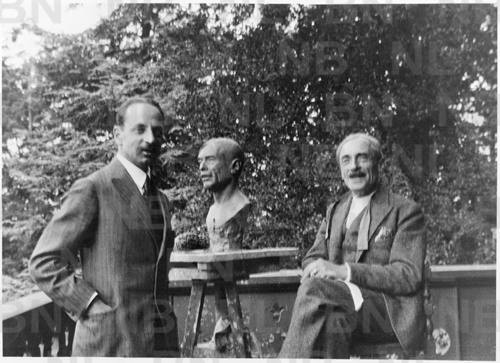
Rilke and Valéry with bust of Valéry
February 1922: having translated Valéry’s “Le Cimitière marin” into German in 1921, Rainer Maria Rilke experienced an intense, “savage,” burst of creativity at the Château de Muzot in Switzerland, resulting in the completion of his masterpieces, the Duino Elegies and the entirety of the fifty-five Sonnets to Orpheus in just three weeks. In the middle of that poetic storm, in February 11, Rilke wrote a letter to his muse, Lou Andreas-Salomé, telling her that the Tenth Elegy, the last one, was completed. Before I translate and transcribe parts of that letter, I want to remind us that Rilke and Lou had travelled to Russia twice, in 1899 with her husband and in 1900 by themselves, when Rilke was twenty-four.
“Lou, dear Lou, so now:
At this moment, this Saturday, the eleventh of February, at 6, I am laying aside my pen after the last completed Elegy, the tenth. That one (even then it was destined to become the last) whose beginning was already written in Duino: „Dass ich dereinst, an dem Ausgang der grimmigen Einsicht / Jubel und Ruhm aufsinge zustimmenden Engeln.“ (Someday, emerging at last from this terrifying vision / may I burst into jubilant praise to assenting angels.) As much as there was of it I read to you, but only just the first twelve lines have remained, all the rest is new and: yes, very, very, very glorious!—Think! I have been allowed to survive up to this. Through everything. Miracle. Grace.—All in a few days. It was a hurricane, as at Duino that time: all that was fiber, fabric in me, framework, cracked and bent. Eating was not to be thought of.
“And imagine, something more, in another context, just previously (in the “Sonnets to Orpheus”, twenty-five sonnets, written, suddenly, in the fore-storm, as a memorial for Vera Knoop).
“I wrote, made, the horse, you know, the free happy white horse with the hobble on its foot that once, at the approach of evening, came galloping toward us on a Volga meadow—:
how I made him as an “ex voto” for Orpheus!—What is time?—When is present? Across so many years he sprang, with his utter happiness, into my wide-open feeling.”
A horse who comes galloping across more than twenty years, all the way from the Russian Volga to the Swiss Vaud, and makes possible Rilke’s homage to the father of singers, to Orpheus. Rilke, in turn, takes me to a sky over Salamanca, to Miguel de Unamuno, who did say something (remember?) about the above questions— What is time? When is present? “We live in remembrance and by remembrance, and at bottom our spiritual life is but our remembrance’s effort to persevere, to turn itself into hope, the effort of our past to turn itself into future.”
Of Rilke’s Sonnets to Orpheus the last one (II, 29) has long been a stumbling block for me:
Stiller Freund der vielen Fernen, fühle,
wie dein Atem noch den Raum vermehrt.
Im Gebälk der finstern Glockenstühle
lass dich läuten. Das, was an dir zehrt,
wird ein Starkes über dieser Nahrung.
Geh in der Verwandlung aus und ein.
Was ist deine leidendste Erfahrung?
Ist dir Trinken bitter, werde Wein.
Sei in dieser Nacht aus Übermass
Zauberkraft am Kreuzweg deiner Sinne,
ihrer seltsamen Begegnung Sinn.
Und wenn dich das Irdische vergass,
zu der stillen Erde sag: Ich rinne.
Zu dem raschen Wasser sprich: Ich bin.
Silent friend from many spans, feel
how your breath amplifies space.
In the frame of the dark bell
let yourself ring. What lives off you
will become stronger from this food.
Go into the transformation, out and in
What’s your most painful experience?
If drinking is bitter, become wine.
Be in this night of excess
magic force at the crossing of your senses,
the sense of their strange encounter.
And if the earthly forgot you,
to the still earth say: I flow.
To the fast water speak: I am.
I find it strange, or downright wrong, to say to that enigmatic, silent friend, feel how his breath amplifies space. One may feel that as one exhales, but breathing includes inhaling, undoing what one did a few seconds before. I find them overwhelming, those metaphoric bells, and when the poet recommends becoming wine when the drink feels bitter, should I interpret it as leaving Fernet or Cynar for another day and switching to Bordeaux or Rioja? Should we recommend Eurydice that if the snake bite was painful, she had better become a snake?
Finally, I decided that the final tercet is Rilke’s substitute for Valéry’s controversial Cruel Zénon, a sort of relativization thereof. In Eleatic fashion, Rilke denies motion when talking to the rushing stream, but to the quiet earth he maintains — following Heraclitus — that he, the poet, flows.
The initial line of the last tercet, however, remained unresolved, enigmatic. What might be the meaning of the earthly, or the earthbound, forgetting you? I thought long and hard: could I, for instance, say that the earthly forgot me? Who, among those I know or have known, could say something like it? The reciprocal, someone who has forgotten the earthly, should be easier to find, at least among the cenobites or the astronauts.
Involved in those cavillations, suddenly Salamanca and its university come back to mind. From one tower, Muñoz gazes at the supernova of 1572; from another, Fray Luis gazes at the stars and composes his poem, already mentioned in Part 1:
When I contemplate the sky,
adorned by countless lights
and I look down to the ground,
in night immersed,
in slumber and in oblivion buried,
love and sorrow
waken a burning anxiety in my heart;
tears fall
from the fountain of my eyes,
Loarte, and I say with voice despondent:
Abode of greatness
temple of clarity and beauty,
the soul that to your height
was born, what misfortune
holds her in this low and gloomy jail?
And the enigmatic line in Rilke’s last sonnet to Orpheus opens up and blooms: here Fray Luis de León, during that night serene, is an example of a man whom the earthly has forgotten, to whom it is prescribed to be and to flow, both.
Ricardo Lida Nirenberg is the editor of Offcourse